
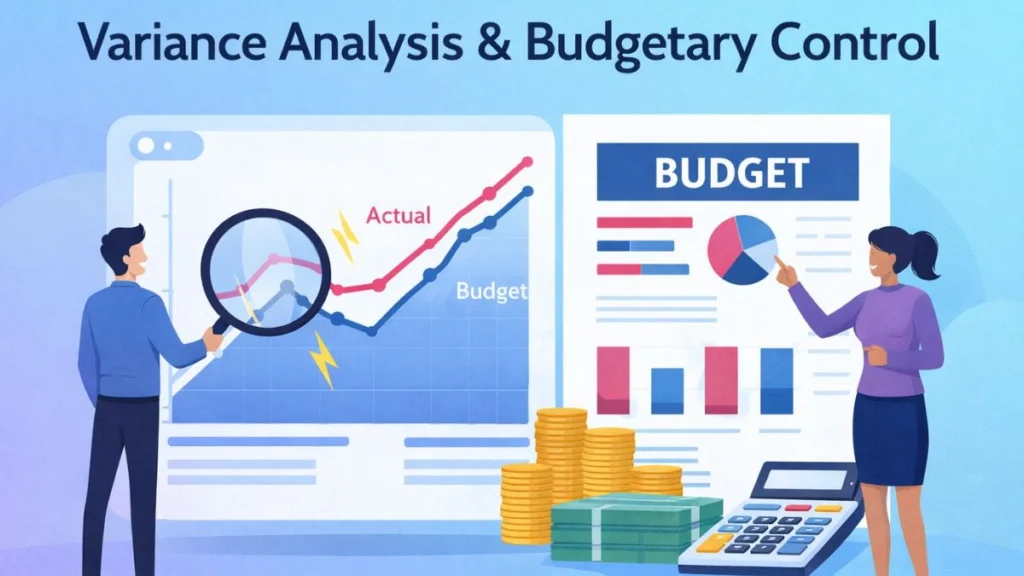

Planning is important, but control is what keeps a business on track. Even the best budgets can fail if actual results are not reviewed and corrected in time. This is where variance analysis and budgetary control play a critical role.
Together, these tools help businesses compare plans with results, identify problems early, and take corrective action before losses grow.
What Is Budgetary Control?
Budgetary control is a system where:
- Budgets are prepared in advance
- Actual performance is recorded
- Results are compared with the budget
- Corrective action is taken when needed
The main goal is to ensure that business activities remain aligned with planned objectives.
Why Budgetary Control Is Important
Budgetary control helps organizations:
- Control costs effectively
- Improve financial discipline
- Coordinate different departments
- Measure performance objectively
- Achieve planned profits
It turns budgets into active management tools, not just paperwork.
What Is Variance Analysis?
Variance analysis is the process of comparing actual results with budgeted figures and analyzing the differences, known as variances.
A variance can be:
- Favorable (better than expected)
- Adverse or unfavorable (worse than expected)
Understanding these variances helps management identify strengths and weaknesses.
How Variance Analysis Supports Budgetary Control
Budgetary control sets the plan, while variance analysis checks performance. Together, they:
- Highlight problem areas
- Explain why results differ
- Support corrective decisions
- Improve future budgeting
Without variance analysis, budgetary control is incomplete.
Types of Variances in Management Accounting
Variance analysis focuses on different cost and revenue elements.
Cost Variances
Differences between actual and budgeted costs.
Sales Variances
Differences between actual and budgeted sales.
Profit Variances
Differences between actual and expected profit.
Each variance tells a different business story.
Material Variances
Material variances include:
- Material price variance
- Material usage variance
They help identify issues like price changes, waste, or inefficient use of materials.
Labor Variances
Labor variances include:
- Labor rate variance
- Labor efficiency variance
They highlight problems such as overtime, low productivity, or wage changes.
Overhead Variances
Overhead variances show whether:
- Fixed costs were controlled
- Variable overheads matched activity levels
They help monitor operational efficiency.
Sales Variances
Sales variances focus on:
- Sales price variance
- Sales volume variance
They explain whether changes in revenue are due to pricing decisions or sales quantity.
Favorable vs Adverse Variances
A favorable variance does not always mean good performance, and an adverse variance does not always mean failure. Management must analyze:
- Causes of variance
- Long-term impact
- Quality and sustainability
Context matters more than numbers alone.
Budgetary Control in Real Business Decisions
Budgetary control is used to:
- Monitor departmental performance
- Control operational costs
- Evaluate managers
- Plan cash flows
- Support strategic decisions
It ensures accountability across the organization.
Role of Variance Analysis in Management Accounting
Variance analysis is a core part of management accounting. Professional bodies like the Institute of Management Accountants emphasize its role in planning, control, and performance evaluation.
Advantages of Variance Analysis & Budgetary Control
Key benefits include:
- Early detection of problems
- Better cost control
- Improved performance measurement
- Informed decision-making
- Continuous improvement
These tools help managers stay proactive, not reactive.
Limitations to Keep in Mind
Despite their value, there are limitations:
- Based on estimates and assumptions
- Time-consuming if over-detailed
- Focus mainly on financial data
- Less effective in fast-changing environments
They should be used with judgment and flexibility.
Best Practices for Effective Budgetary Control
To get the best results:
- Set realistic budgets
- Involve managers in budgeting
- Review variances regularly
- Focus on significant variances
- Take timely corrective action
Good systems depend on good implementation.
Why Variance Analysis Matters for Business Growth
Businesses that track variances consistently:
- Learn from past performance
- Improve forecasting accuracy
- Strengthen cost discipline
It turns mistakes into learning opportunities.
Final Thoughts
Variance Analysis & Budgetary Control help businesses move from planning to control. By comparing what was planned with what actually happened, managers can correct mistakes, improve efficiency, and achieve better results.
Frequently Asked Questions (FAQs)
What is variance analysis in simple terms?
It compares actual results with budgeted figures.
What is budgetary control?
It is a system for planning and controlling business activities through budgets.
Are variance analysis and budgetary control the same?
No. Variance analysis supports budgetary control.
What is a favorable variance?
When actual performance is better than budgeted.
Is an adverse variance always bad?
Not always—it needs analysis.
Who uses variance analysis?
Managers, accountants, and business owners.
Is variance analysis useful for small businesses?
Yes, it helps control costs at any scale.
How often should variances be analyzed?
Regularly—monthly or quarterly.
Does variance analysis improve decision-making?
Yes, by highlighting problem areas.
Is variance analysis part of management accounting?
Yes, it is a core management accounting tool.