
Businesses often struggle when sales, marketing, and customer success teams operate in silos. Leads slip through the cracks, campaigns underperform, and revenue growth slows.
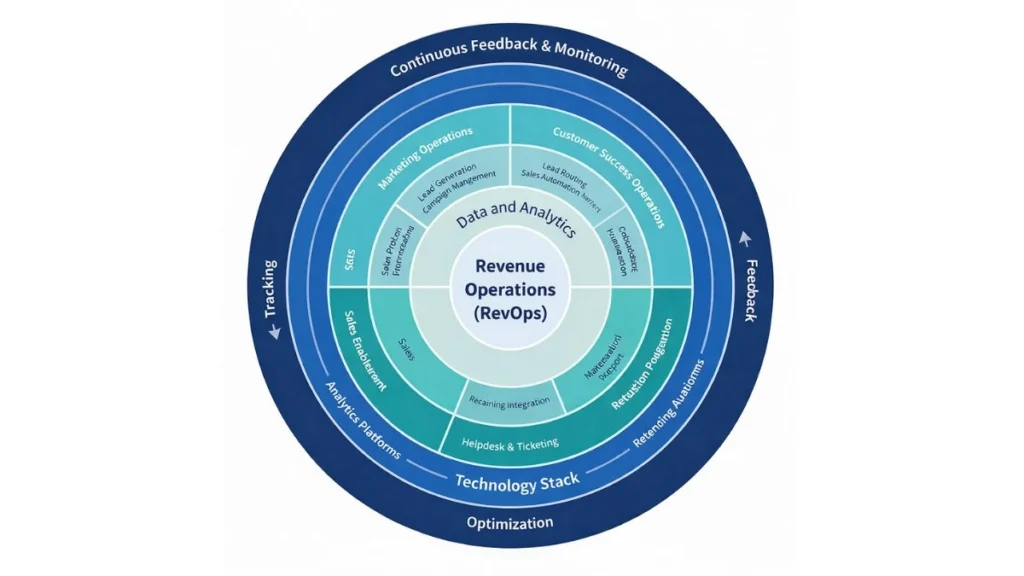
Revenue Operations (RevOps) is a strategic approach that aligns these teams using data, processes, and technology to optimize revenue. Integrating RevOps with your CRM ensures that every touchpoint—from lead capture to customer retention—is tracked, measured, and optimized.
In this article, we’ll explore CRM + RevOps, why it matters, how to implement it, and the benefits it delivers for your business.
What Is CRM + RevOps?
Revenue Operations (RevOps) is the alignment of marketing, sales, and customer success to maximize revenue growth. It focuses on process standardization, unified data, and operational efficiency.
When combined with a CRM, RevOps leverages customer and operational data to:
- Track revenue from lead to renewal
- Optimize cross-department workflows
- Provide actionable insights for revenue growth
Essentially, CRM + RevOps ensures that all revenue-related teams operate from a single source of truth, enabling smarter decision-making and better collaboration.
Why CRM + RevOps Matter
- Break Down Silos
Aligns sales, marketing, and customer success so everyone works toward shared revenue goals. - Improve Forecast Accuracy
With consistent data and standardized processes, revenue predictions are more accurate. - Enhance Customer Experience
Teams can respond faster, deliver personalized interactions, and resolve issues before they impact revenue. - Increase Efficiency
Automates workflows across departments, reducing manual data entry and redundant tasks. - Optimize Revenue Growth
Data-driven insights identify bottlenecks and opportunities in the revenue cycle, enabling strategic improvements.
Key Components of CRM + RevOps
- Data Management – Clean, unified, and accessible customer and revenue data across teams
- Process Alignment – Standardized workflows from lead capture to post-sale support
- Automation – Trigger tasks, alerts, and follow-ups across departments automatically
- Analytics and Reporting – Track KPIs like pipeline velocity, conversion rates, churn risk, and customer lifetime value
- Technology Stack Integration – Connect CRM, ERP, marketing automation, and support tools to provide a holistic view
How CRM + RevOps Works
Step 1: Align Teams and Goals
Ensure sales, marketing, and customer success share revenue objectives and KPIs.
Step 2: Centralize Data in CRM
Integrate all customer and operational data into your CRM for a single source of truth.
Step 3: Standardize Processes
Define workflows for lead management, deal progression, and customer support interactions.
Step 4: Automate Revenue Workflows
Use CRM automation to trigger follow-ups, assign leads, and escalate issues proactively.
Step 5: Analyze and Optimize
Regularly review dashboards and reports to identify bottlenecks, improve pipeline velocity, and increase overall revenue.
Benefits of CRM + RevOps
- Improved Revenue Predictability – Accurate forecasts with fewer surprises
- Faster Lead-to-Customer Conversion – Streamlined workflows reduce friction
- Better Collaboration – Teams share insights, goals, and processes
- Enhanced Customer Retention – Proactive engagement reduces churn
- Data-Driven Decisions – Actionable insights from unified CRM data
Popular Tools for CRM + RevOps
- Salesforce CRM + Revenue Cloud – Enterprise-grade solution for sales, service, and marketing alignment
- HubSpot CRM + Operations Hub – Streamlines processes and provides data insights for SMBs
- Zoho CRM + RevOps Modules – Unified platform for marketing, sales, and customer success
- Gong + CRM Integration – Conversation analytics for revenue intelligence
- Clari + Salesforce – AI-driven revenue forecasting and pipeline visibility
Common Use Cases
- Pipeline Visibility Across Teams – Monitor leads, deals, and revenue across marketing, sales, and success
- Revenue Forecasting – Predict revenue and identify gaps in performance
- Customer Journey Optimization – Ensure consistent engagement from lead to renewal
- Churn Prevention – Identify at-risk customers and take proactive measures
- Campaign ROI Analysis – Measure which marketing initiatives drive actual revenue
Conclusion
CRM + Revenue Operations (RevOps) transforms how businesses manage revenue by aligning sales, marketing, and customer success. With unified data, standardized workflows, and automation, your teams can increase efficiency, improve customer experience, and drive predictable revenue growth.
For businesses looking to scale, adopting a CRM + RevOps strategy isn’t just smart—it’s essential for sustainable success.
FAQs About CRM + RevOps
Q1: Is RevOps only for large enterprises?
No. Businesses of all sizes benefit from aligning sales, marketing, and customer success to optimize revenue.
Q2: How does CRM help RevOps?
CRM centralizes customer data, tracks interactions, and automates workflows, providing the foundation for RevOps success.
Q3: Do I need a separate RevOps team?
Not necessarily. Smaller businesses can start by aligning existing teams and gradually adopting a RevOps framework.
Q4: Can RevOps integrate with ERP or other systems?
Yes. Integrating ERP, marketing automation, and support tools ensures full visibility into revenue operations.
Q5: How soon can I see results?
Depending on your processes and data quality, initial improvements in efficiency and pipeline visibility can appear within weeks. Revenue growth may take a few months.